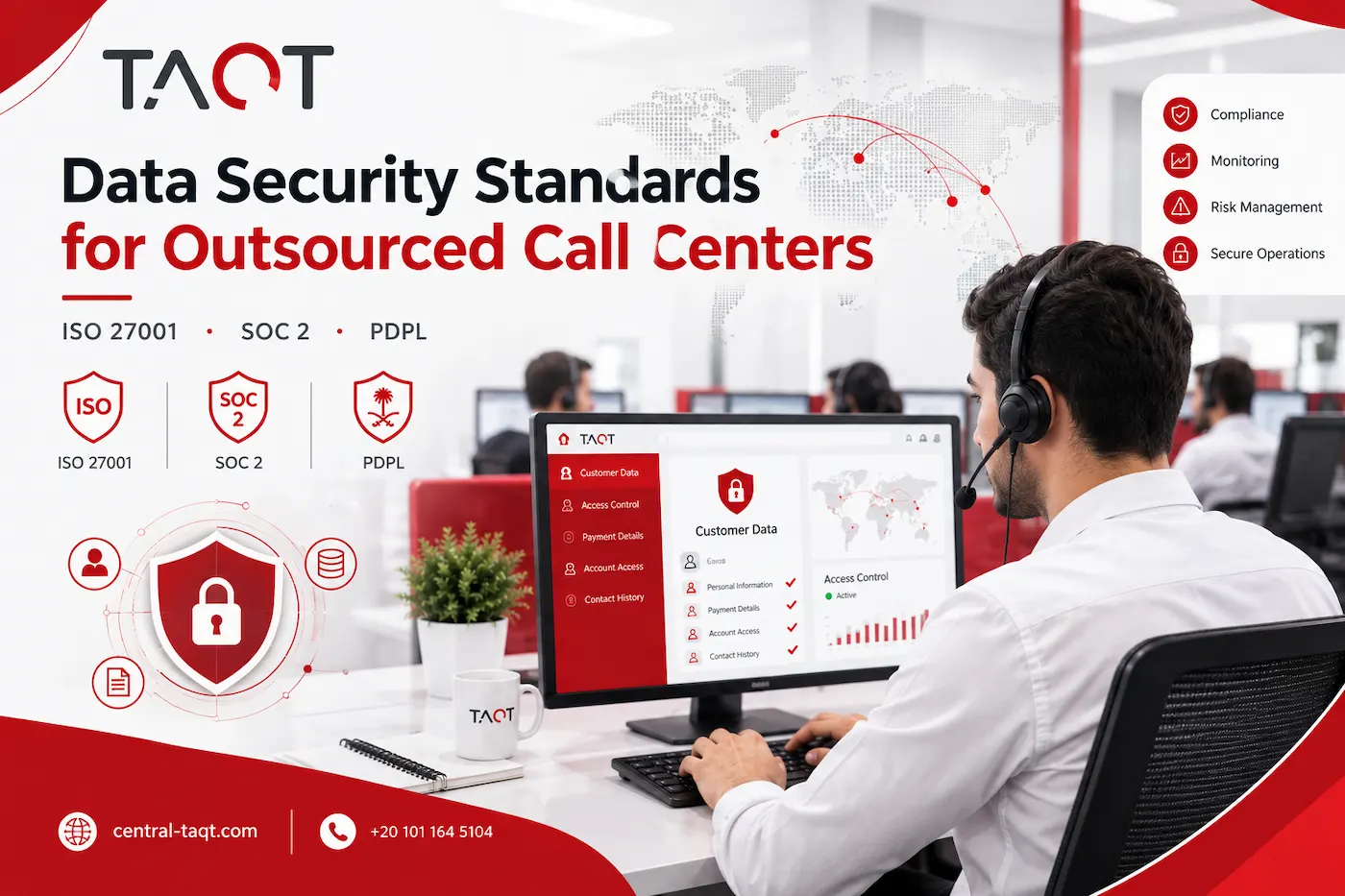
A single leaked customer record can undo years of trust and if that record moved through a vendor’s call floor, the damage lands on your brand, not theirs. That’s why data security standards for outsourced call centers have moved from a procurement checkbox to a board-level concern for compliance officers, IT leads, and anyone signing off on a BPO contract. Regulators across the Gulf are no longer lenient about “the vendor made the mistake” under laws like Saudi Arabia’s PDPL, the company that owns the customer relationship stays accountable for what its outsourcing partner does with that data.
This guide breaks down exactly which certifications matter, what regional data protection law requires, which red flags signal a vendor cutting corners, and the specific questions to put in front of any BPO before a contract gets signed.
Why Data Security Is the First Question to Ask a BPO Partner
Short answer: Data security should be the first filter in vendor selection because a call center handles your most sensitive customer touchpoints payment details, ID numbers, health information, and account credentials often with agents who have never met you face to face.
Call centers are a favored attack target precisely because they combine high call volume with human access to sensitive systems. Agents authenticate customers, pull up account records, process payments, and sometimes reset credentials every one of those actions is a potential exposure point if the underlying controls are weak. A vendor that leads with price and seat count but glosses over security architecture is signaling where its priorities actually sit.
Before evaluating cost, evaluate exposure. Ask what data the vendor’s agents will actually touch, where that data is stored, who can access it, and what happens the day a laptop goes missing or an agent’s credentials are phished. If a sales rep can’t answer those questions without looping in someone else, that’s already useful information.
ISO 27001 vs. SOC 2 What Each Certification Actually Covers
Short answer: ISO 27001 certifies that a vendor runs a full information security management system (ISMS) across the whole organization, while SOC 2 is an attestation report issued by a licensed CPA firm rather than a certification body confirming that specific security controls were tested and found effective over a review period.
The two are often mentioned in the same breath, but they’re built differently and buyers should know the distinction before treating either as a rubber stamp.
ISO 27001 is an internationally recognized standard maintained jointly by ISO and IEC. It requires an organization to build and continuously improve an ISMS covering risk assessment, access control, incident response, physical security, and vendor management and it applies at the organizational level, not just to one product or service line. Because the scope is broader and the requirements are prescriptive, ISO 27001 audits tend to take longer and cost more than SOC 2 engagements.
SOC 2 was developed by the AICPA and evaluates a service organization against five Trust Services Criteria: security, availability, processing integrity, confidentiality, and privacy. It’s an attestation, not a certificate, and it’s scoped to a specific system or service rather than the whole company. SOC 2 is especially common among vendors serving US and North American enterprise clients, while ISO 27001 carries more recognition across Europe, Asia, and regulated Gulf markets including Saudi Arabia.
The two frameworks overlap heavily on underlying controls, so a mature vendor holding both is demonstrating security discipline from two different angles rather than duplicating effort for marketing purposes.
| Criteria | ISO 27001 | SOC 2 |
| Issued by | Accredited certification body | Licensed CPA firm |
| Output | Certificate | Attestation report |
| Scope | Organization-wide ISMS | Specific system or service |
| Global recognition | Strong across Europe, Asia, GCC | Strongest in North America |
| Renewal cycle | 3-year certificate, annual surveillance audits | Annual (Type II covers a review period) |
| Best signals for | Regulated, multi-country operations | US/enterprise SaaS-style vendor relationships |
For a call center handling regulated data across multiple markets, ask for the current certificate or report itself not a logo on the website and check the scope statement to confirm it actually covers the operations your data will run through.
Data Protection Rules That Apply to Outsourced Call Centers in Saudi Arabia and the Gulf (PDPL)
Short answer: Saudi Arabia’s Personal Data Protection Law (PDPL) requires any organization processing the personal data of individuals in the Kingdom including outsourced vendors and their sub-processors to have a lawful basis for processing, apply proportionate technical and organizational safeguards, and control cross-border data transfers, with the data controller remaining accountable for how its processor handles that data.
PDPL was enacted by Royal Decree in 2021, amended in 2023, and became fully enforceable on 14 September 2024 after a one-year grace period. It’s regulated by the Saudi Data and Artificial Intelligence Authority (SDAIA), with sector regulators such as SAMA and CMA layering on additional requirements for outsourcing, cloud use, and operational resilience in financial services. Enforcement is active: SDAIA’s committees have issued dozens of decisions since 2024, most commonly citing missing legal basis for processing, unauthorized disclosure, and failure to implement adequate technical safeguards.
A few specifics matter directly for outsourced call centers:
- Processor accountability flows both ways. Even when a BPO fully handles customer interactions, the company that owns the data stays legally responsible for how the vendor processes it. Contracts need PDPL-compliant data processing terms, not generic confidentiality clauses.
- Cross-border transfer controls apply. If a vendor’s agents, servers, or backup systems sit outside Saudi Arabia including remote access by staff located abroad that’s treated as a cross-border transfer requiring documented safeguards.
- Data subject rights need operational support. Customers can request access, correction, deletion, or consent withdrawal, and the vendor’s systems need to support fulfilling those requests within the required response window.
- Sensitive data draws sharper scrutiny. Payment details, health information, and national ID data carry criminal penalties for unlawful handling, on top of administrative fines that can reach into the millions of riyals.
If your BPO partner can’t describe where your data physically sits, who can access it remotely, and how it supports a data subject access request, that’s a PDPL exposure not just a security one.
Red Flags That Signal a Vendor Isn’t Compliant
Short answer: The clearest warning signs are vague answers about data location, no named security or compliance owner, certifications that can’t be verified independently, and reluctance to let you audit or review their controls before signing.
Watch for these patterns during vendor evaluation:
- No named certificate or report only a claim of being “ISO compliant” without a certificate number, issuing body, or scope you can verify.
- Shared or unmanaged devices on the call floor, or agents allowed to use personal phones and laptops for work tasks.
- Unclear sub-processor chain the vendor outsources part of the work to another firm without disclosing it or extending the same contractual protections.
- No breach notification clause, or one with response timelines vague enough to be meaningless in practice.
- Resistance to a security questionnaire or on-site/virtual audit before contract signature a compliant vendor should welcome this, not delay it.
- High agent turnover with light background screening, which increases the odds that untrained or unvetted staff are handling sensitive calls.
None of these are automatically disqualifying on their own, but two or more together usually mean the vendor’s security program exists on paper more than in practice.
Questions to Ask Before Signing a Contract
Bring these directly into vendor calls and RFPs the quality of the answer matters more than the answer itself:
- What certifications do you currently hold, and can you share the certificate or the report’s scope section?
- Where physically is customer data stored and processed, and does any part of the workflow cross a national border?
- Who has access to our data, and how is that access logged and reviewed?
- What is your breach notification timeline, and what does the escalation path look like?
- How do you screen and train agents before they handle sensitive calls?
- Do you use any sub-processors, and are they held to the same contractual security terms?
- How do you support a data subject’s request to access, correct, or delete their information?
- What happens to our data and any copies or backups at the end of the contract?
A vendor that answers these clearly, with named documents and specific numbers rather than reassurance, is telling you something real about how the operation actually runs which matters as much as headcount or call center outsourcing cost when comparing proposals.
How Central Tact Protects Client Data
Central Tact builds security into the operational layer, not as an add-on after the seats are staffed. That means role-based access controls so agents only see the data relevant to their queue, monitored and managed devices across the call floor, documented incident response procedures, and contractual terms aligned with PDPL’s processor accountability requirements for clients operating in Saudi Arabia and the wider Gulf.
Every engagement starts with a clear data-handling scope: what information agents will touch, where it’s stored, who can access it, and how that access is reviewed over time. This is the same operational discipline behind our broader call center outsourcing services security isn’t a separate module, it’s part of how the floor runs day to day. If you want the full breakdown of what’s included, our services page covers the operational and compliance layers together.
If your organization is currently vetting outsourcing partners and needs a straight answer on how a specific process would be secured, the fastest way to get one is to talk to the team directly reach us on WhatsApp or through our contact page.
FAQ
What is the most important data security certification for a call center vendor?
There isn’t a single “most important” one it depends on where your customers are. ISO 27001 carries the most weight for GCC and international operations, while SOC 2 is expected by many North American enterprise buyers. A vendor serving regulated Gulf markets should be able to show ISO 27001 at minimum.
Does PDPL apply if the call center is physically located outside Saudi Arabia?
Yes. PDPL has extraterritorial reach and applies to any organization processing the personal data of individuals located in Saudi Arabia, regardless of where the processing entity is based, which is why cross-border transfer safeguards matter even for offshore BPO arrangements.
How often should a vendor’s security certifications be re-verified?
ISO 27001 certificates run on a three-year cycle with annual surveillance audits, and SOC 2 Type II reports typically cover a rolling 12-month period. Ask for the current, dated document at contract signing and again at each renewal an expired certificate is effectively no certificate.
Can a BPO vendor be PDPL compliant without holding ISO 27001 or SOC 2?
Technically yes, since PDPL doesn’t mandate a specific certification it requires “proportionate” technical and organizational safeguards. In practice, a recognized certification is the fastest way for a vendor to demonstrate that those safeguards actually exist rather than asking you to take their word for it.
What happens if my outsourcing vendor has a data breach?
Under PDPL, the data controller typically your company remains accountable to regulators and affected individuals even when the breach originates at a processor. This is why the contract’s breach notification clause and timeline matter as much as the vendor’s preventive controls.
Is it more expensive to work with a vendor that holds both ISO 27001 and SOC 2?
Usually, yes, since maintaining both frameworks costs the vendor more in audit fees and documentation overhead, and that cost is generally reflected in pricing. It’s worth weighing that premium against the exposure of working with an unverified vendor, especially for regulated data types like payment or health information.
Should security requirements be written into the outsourcing contract itself, not just discussed verbally?
Yes, always. Verbal assurances about “taking security seriously” carry no weight in a PDPL enforcement review or a breach investigation. Data handling scope, access controls, sub-processor disclosure, and breach notification timelines need to be contractual terms, not sales-call talking points.
Vetting a BPO partner on data security means going past the certification logos and asking for the actual documents, the actual data flow, and the actual contract language ISO 27001 or SOC 2 status, PDPL-aligned processing terms, and a breach notification clause with real timelines. Get those three things confirmed in writing before you sign anything. If you’re currently comparing outsourcing partners and want a straight conversation about how your specific data would be handled, reach out on WhatsApp or through our contact page Central Tact’s team can walk you through exactly how we protect client data.