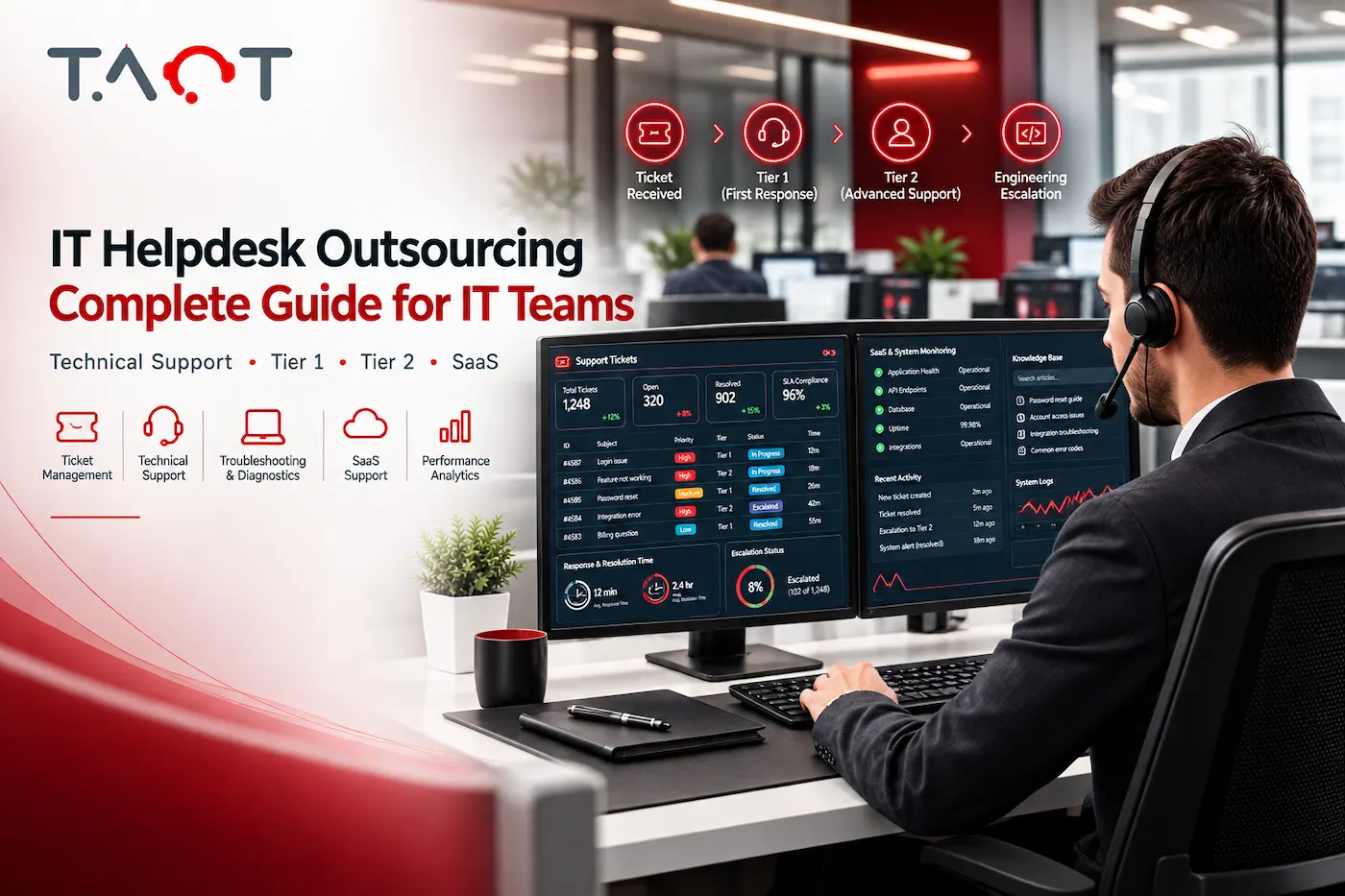
When ticket volume outpaces your engineering headcount, IT helpdesk outsourcing is usually the fastest way to close the gap without pulling developers off the roadmap. Done well, it gives IT managers a dedicated support layer that resolves password resets, login errors, and integration bugs before they reach a senior engineer. Done poorly, it becomes a scripted call center that frustrates users and hurts retention.
This guide covers what IT helpdesk outsourcing includes, which support tiers make sense to hand off, how the economics compare to hiring in-house, and the signals that it’s time to bring in a partner.
What Is IT Helpdesk and Technical Support Outsourcing?
IT helpdesk outsourcing is the practice of hiring an external provider to handle some or all of a company’s technical support workload password resets, account access, troubleshooting, bug triage, and system monitoring instead of staffing that function entirely in-house.
For SaaS companies, this looks different from traditional enterprise IT outsourcing: instead of supporting employees with laptop or VPN issues, the outsourced team supports paying customers who rely on the product to run their own business, which raises the stakes on response time and product knowledge.
A well-run outsourced helpdesk typically covers:
- Ticket triage and first response across email, chat, and phone
- Password, login, and account access issues
- Known-issue troubleshooting via a shared knowledge base
- Bug reproduction and structured escalation to engineering
- Uptime and system alert monitoring
IMARC Group estimated the global help desk outsourcing market at roughly $10.4 billion in 2025, nearly doubling by 2034. Deloitte’s most recent Global Outsourcing Survey found most executives plan to maintain or increase investment in third-party IT providers, citing cost control and specialized skills as top drivers.
Tier 1, Tier 2, and Tier 3 Support What Gets Outsourced
Structuring support by tier keeps an outsourced helpdesk fast without putting your core product knowledge at risk.
Tier 1 handles volume: password resets, basic navigation, known-issue lookups, and ticket categorization repetitive work suited to documented playbooks, and usually the first tier companies outsource.
Tier 2 goes deeper: reproducing bugs, checking logs, testing integrations. It’s outsourcable, but only to a team trained on your product with real tool access.
Tier 3 is specialist-level: source code review, infrastructure debugging, and engineer-only issues. Most companies keep this in-house and use the outsourced team as a filter that escalates only genuine Tier 3 problems.
| Support Tier | Typical Issues | Best Fit for Outsourcing |
| Tier 1 | Password resets, FAQs, navigation, ticket routing | Fully outsourced |
| Tier 2 | Bug reproduction, integration checks, log review | Outsourced, trained agents |
| Tier 3 | Code-level fixes, infrastructure, security | Kept in-house |
A tier 1 tier 2 support outsourcing model built this way protects engineering time while giving customers fast, competent answers.
Technical Support vs. General Customer Support Outsourcing
These two get bundled together, and the mismatch is where outsourcing projects go wrong. General customer support outsourcing covers billing, order status, and product guidance work that leans on communication skills and a script.
A technical support outsourcing company needs something extra: agents who can read logs, reproduce a bug in staging, and write that back to an engineer in language they can act on. An agent great at de-escalating an angry customer isn’t automatically equipped to diagnose a silently failing webhook.
The takeaway: when evaluating an outsourced tech support team, ask for the technical background of the agents who’ll staff your account, not just CSAT scores. AI and SaaS companies especially need a partner comfortable with product logs and structured bug reports see our guide to customer support outsourcing for AI companies.
Signs Your Product Team Needs Outsourced Technical Support
A few patterns tend to show up before a company brings in outsourced IT support:
- Response times keep creeping past your SLA.
- Engineers are doing Tier 1 work instead of shipping code.
- Coverage gaps outside business hours, especially for users across time zones.
- Headcount can’t scale with usage spikes from launches or seasonal peaks.
- Ticket backlog keeps growing week over week, even with overtime.
- Churn correlates with support wait times in your retention data.
If two or more sound familiar, it’s usually cheaper and faster to bring in a help desk outsourcing company than to keep patching the gap with overtime.
Cost of Outsourced Technical Support vs. In-House Engineers
The cost case rarely comes down to headline salary alone it’s total cost: recruiting, training, tooling, benefits, and turnover.
HDI’s Technical Support Practices & Salary Report puts the median cost per phone-based contact at $15.56, versus roughly $0.10 for a self-service resolution, showing why triage and knowledge bases matter as much as headcount. Industry data also shows the average U.S. help desk agent stays under two and a half years, with replacement costs running into the thousands once recruiting and ramp-up are factored in.
| Factor | In-House Engineer | Outsourced Support |
| Hiring timeline | 4–10 weeks per hire | Days to a few weeks |
| Coverage | Limited to contracted hours | 24/7 available |
| Cost structure | Salary + benefits + tooling | Scalable, per agent/ticket |
| Turnover risk | Full re-hiring cost | Absorbed by partner |
| Scaling for spikes | New hires or overtime | Flex capacity in contract |
| Ramp-up time | Weeks per hire | Managed by provider |
This isn’t an argument for outsourcing everything Tier 3 and core engineering should stay in-house. But for Tier 1 and much of Tier 2, the outsourced model typically costs less per resolved ticket while giving coverage an in-house team the same size couldn’t match.
If your team runs support through Zendesk, see how outsourced agents integrate into existing chat workflows on our page for outsourcing Zendesk chat.
How Central Tact Builds Technical Support Teams
Central Tact builds outsourced technical support teams around the product first, not a generic call-center script. Every engagement starts with a knowledge-transfer phase where agents work through your product and common ticket types before touching a live queue the same approach used across our full range of outsourced support services.
Teams are structured by tier: Tier 1 agents handle volume from day one, while Tier 2 specialists are matched to your tech stack and trained to reproduce bugs and write escalation reports engineers can act on. Coverage is built around your users’ time zones, with reporting on resolution time, escalation rate, and ticket volume from week one so engineers only see tickets that genuinely need them.
Ready to see what a dedicated technical support team looks like for your product? Contact us or message us on WhatsApp to discuss your ticket volume and current setup.
IT Helpdesk Outsourcing for Saudi Arabia: What to Look For
Saudi Arabia’s tech and SaaS market is growing alongside the country’s wider digital transformation push, which raises expectations for fast, competent technical support. If your product serves Saudi customers, a few factors matter when choosing an outsourced helpdesk partner:
- Arabic and English support: Agents should handle tickets, chat, and calls in both languages, and write escalation reports to engineering in clear English.
- Time-zone and working-week coverage: Support hours should follow Arabia Standard Time (UTC+3) and the local working week, not just your home office schedule.
- Data protection awareness: Agents often see customer accounts and logs, so your partner should understand Saudi Arabia’s Personal Data Protection Law (PDPL) and enforce strict access controls.
- Product-first training: The same rule applies here as anywhere: agents trained on your product resolve Tier 1 and Tier 2 tickets faster than agents following a generic script.
A partner that covers these points lets you offer Saudi customers local-feeling, round-the-clock support without building a full in-house team in the region.
FAQ
What is IT helpdesk outsourcing?
Hiring an external company to handle technical support tasks password resets, troubleshooting, bug triage, and ticket management instead of staffing that function entirely in-house.
Is IT helpdesk outsourcing only for large enterprises?
No. Growing SaaS companies outsource technical support just as actively as enterprises, since it lets a small team offer 24/7 coverage without full-time hires for every shift.
How much does outsourced technical support cost compared to hiring in-house?
It depends on volume and tier mix, but Tier 1 and Tier 2 support is typically priced per agent or per ticket, avoiding the recruiting, benefits, and turnover costs of in-house hires.
Can an outsourced team handle technical, product-specific issues?
Yes, when the provider trains agents on your product rather than a generic script. Tier 2 agents can reproduce bugs and test integrations with real product access and proper onboarding.
What’s the difference between technical support and general customer support outsourcing?
Technical support needs agents who can read logs and reproduce bugs for engineers, while general customer support focuses on billing and account questions. The skills overlap but aren’t interchangeable.
Should Tier 3 support ever be outsourced?
Rarely. It involves source code and infrastructure changes needing deep internal context, so companies keep it in-house and let outsourced teams escalate only genuine Tier 3 issues.
How quickly can an outsourced help desk team get started?
Typically within a few weeks, versus four to ten weeks per in-house hire, since the provider handles recruiting and training in parallel.
Does outsourcing technical support hurt customer experience?
Not when structured correctly it tends to improve experience via faster response times and 24/7 coverage. The risk is under-trained agents or a provider that skips product knowledge transfer.