Policyholders in the Gulf now expect a claim update within minutes, not days, and a renewal call answered on the first ring. When an insurer’s internal team can’t keep pace with that expectation — especially during a catastrophic weather event or an open-enrollment surge — service quality drops exactly when it matters most. This is why insurance call center outsourcing has become a standard operational strategy for insurance companies and brokers across the region rather than a last resort. This guide walks through what it actually involves, what it costs compared to an in-house team, and how a structured partner sets up your account from day one.
What Is Insurance Call Center Outsourcing?
Insurance call center outsourcing is the practice of handing policyholder-facing communication — claims intake, renewals, billing questions, and complaints — to a specialized external team that operates under your brand.
It’s not the same as a generic answering service. A properly built outsource insurance call center works inside your existing systems (CRM, policy administration platform, claims software) and follows your approved scripts, escalation rules, and compliance procedures, so the policyholder experience feels identical to calling your own office. The provider supplies the agents, the training, the technology stack, and the quality controls; you keep ownership of the relationship and the data.
For brokers and mid-size insurers in particular, this model solves a specific problem: building licensed, insurance-trained staff in-house is slow and expensive, while outsourcing gives access to a ready-made insurance bpo services team that can scale up or down with call volume.
Core Functions: Claims, Renewals, Policy Inquiries, and Complaints
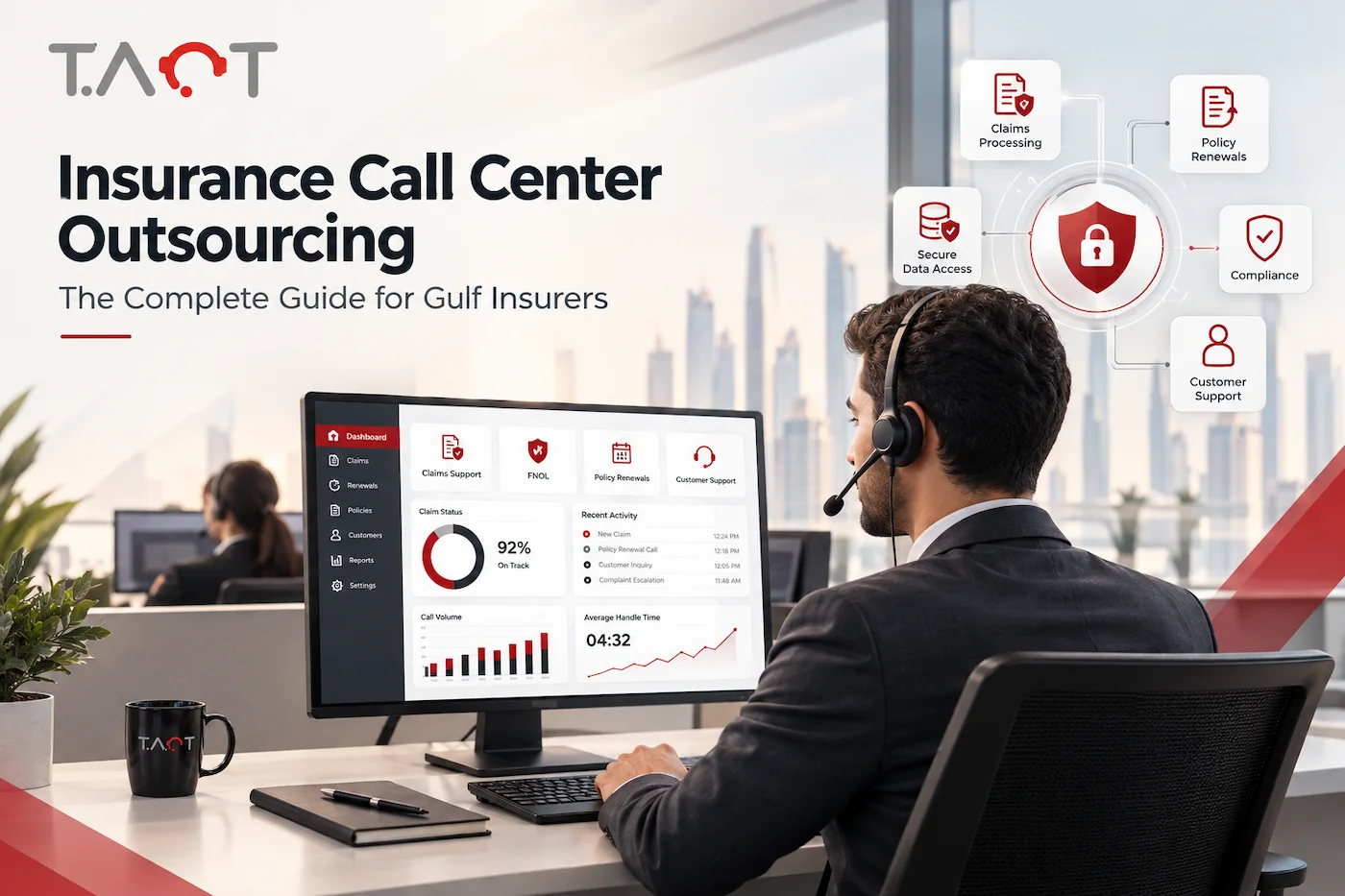
A well-structured outsourced team typically covers four pillars of policyholder contact:
| Function | What the team handles | Why it matters |
| Claims support | First Notice of Loss (FNOL), document collection, status updates | Fastest-growing driver of call volume; delays here damage retention the most |
| Policy renewals | Renewal reminders, payment collection, coverage adjustments | Directly protects recurring revenue |
| Policy inquiries | Coverage questions, endorsements, certificate requests | Reduces churn from confused or frustrated policyholders |
| Complaints & escalations | First-response handling, structured escalation to internal teams | Protects brand reputation and regulatory standing |
An insurance claims call center is usually the highest-value function to outsource first, because claims interactions are both the most frequent and the most emotionally charged calls an insurer receives. Getting FNOL intake right — accurate details, empathetic tone, fast handoff to adjusters — has a measurable effect on customer satisfaction scores and claim-cycle time.
Policy renewal call center outsourcing is the second priority for most insurers, since renewal calls are sales-adjacent: a missed or poorly handled renewal call is a lost policy, not just a missed interaction.
Why Insurers Are Outsourcing Customer Support in 2026
Three forces are pushing insurers toward outsourced support this year:
Rising service expectations. Policyholders compare their insurer’s response time to every other digital service they use, not just to other insurers. They expect quick answers, personalized support, and seamless communication, especially during critical moments like claims filing or open enrollment, and most in-house teams struggle to sustain that standard alone.
A shift in why companies outsource. The reasoning behind outsourcing has changed. Recent industry survey data shows that only about a third of organizations now name cost reduction as their primary driver, while a larger share prioritize access to specialized talent — meaning outsourcing today is chosen for expertise and scalability as much as for savings.
Automation-backed efficiency. Modern outsourced insurance support team providers pair trained agents with intelligent routing and document processing. Industry reporting indicates automation can reduce claims processing time by up to 50 percent, improving both accuracy and customer satisfaction — a gain that’s difficult to replicate with a purely manual in-house process.
If your team is exploring broader options beyond insurance-specific support, our call center outsourcing services page covers the full range of models available.
Compliance Considerations for Outsourced Insurance Support
Insurance is one of the most regulated industries a call center partner will ever support, so compliance can’t be an afterthought. Before signing with any provider, insurers should confirm the following:
- Data protection and confidentiality — how policyholder personal and medical data is stored, transmitted, and access-controlled.
- Regulatory alignment — the partner understands the licensing and disclosure rules that apply to insurance communications in your specific market, since requirements differ across Gulf jurisdictions.
- Call recording and audit trails — every interaction should be recorded, timestamped, and retrievable for regulatory review or dispute resolution.
- Scripted disclosures — agents must use approved wording for claims decisions, denials, and complaint handling, since informal phrasing can create legal exposure.
- Staff vetting and training — agents handling claims and billing data should go through background checks and insurance-specific certification, not just general call center training.
A serious outsourcing partner will document all of this upfront rather than leaving it as a verbal assurance. This is also where outsourcing intersects with adjacent services — insurers dealing with overdue premiums often pair their support desk with our debt collection outsourcing services to keep collections compliant and separate from customer service scripting.
Cost of Outsourcing vs. Maintaining an In-House Team
The cost comparison rarely favors an in-house build once recruitment, training, technology, and management overhead are counted honestly.
| Cost factor | In-house team | Outsourced team |
| Hiring & recruitment | Ongoing, insurer-funded | Included in provider’s setup |
| Training (insurance-specific) | Built from scratch, 4–8 weeks typical | Pre-trained agents, faster ramp-up |
| Technology & CRM integration | Insurer purchases and maintains | Often provided or integrated by partner |
| Scaling for seasonal spikes | Requires temp hiring, slow to adjust | Flexible, adjusted within days |
| Management overhead | Insurer manages shifts, QA, coaching | Partner manages daily operations |
| Compliance monitoring | Insurer builds internal audit process | Built into the partner’s SOPs |
The real advantage isn’t just the line-item cost — it’s the flexibility. An in-house team is sized for average volume, which means it’s either overstaffed in quiet months or overwhelmed during a claims surge. An outsourced insurance customer support model absorbs that variability without the insurer carrying idle payroll.
For a fuller breakdown of pricing models and how they compare across service types, our our services page lists what’s typically included at each tier.
How Central Tact Structures Insurance Support Accounts
Every insurance account is built around four stages rather than a single generic onboarding:
- Discovery and mapping — we document your current claims, renewal, and complaint workflows before writing a single script, so the outsourced team mirrors your process instead of replacing it.
- Agent selection and training — agents assigned to insurance accounts go through insurance-specific onboarding covering FNOL handling, coverage terminology, and complaint escalation, not generic customer service training.
- System integration — where possible, we connect directly into your CRM or policy platform so call notes, claim statuses, and renewal flags update without manual re-entry.
- Quality monitoring and reporting — call scoring, complaint-resolution tracking, and monthly performance reviews so you can see exactly how the outsourced team is performing against your own KPIs, not just the provider’s internal metrics.
This structure is what separates an insurance customer service outsourcing partner from a basic answering service — the goal is an extension of your operations team, not a detached vendor.
Build Your Outsourced Insurance Support Team — Get a Free Consultation
FAQ
What does insurance call center outsourcing include?
It typically includes claims intake (FNOL), policy renewal calls, billing and coverage inquiries, and complaint handling, all delivered under your brand and integrated with your existing systems.
How much does it cost to outsource an insurance call center?
Pricing usually depends on call volume, service hours (24/7 vs business hours), and complexity of claims handled. Most providers offer per-agent, per-hour, or per-call pricing models — request a quote based on your actual volume for an accurate figure.
Is outsourced insurance support compliant with data protection regulations?
A properly vetted provider builds compliance into its processes — including secure data handling, call recording, and regulator-aligned disclosures — rather than treating it as optional. Always confirm this in writing before signing.
Can outsourcing handle claims during a catastrophic event?
Yes — this is one of the strongest use cases. Outsourced teams can scale agent numbers within days to absorb the call surge that follows severe weather events or mass claims incidents, something in-house teams struggle to do quickly.
Do outsourced agents work under my company’s brand?
Yes. Agents answer using your company name, approved scripts, and escalation rules, so policyholders experience the call as if it came from your internal team.
How long does it take to set up an outsourced insurance support team?
Setup typically takes a few weeks, covering workflow discovery, agent training, and system integration — faster if the provider already has insurance-trained staff available.
What’s the difference between insurance BPO and a basic call center?
A basic call center answers and routes calls. Insurance BPO services go further — handling claims processing, policy administration tasks, and compliance-sensitive documentation, not just phone conversations.
Can I outsource only claims or only renewals instead of full support?
Yes. Most providers, including Central Tact, structure engagements by function, so you can start with claims support alone and add renewals or billing later as volume or trust grows.
Ready to reduce response times and control costs on your policyholder support? Contact us to scope your account, or reach out directly on WhatsApp — Build Your Outsourced Insurance Support Team — Get a Free Consultation.