
Do you know exactly why your contact center’s First Call Resolution rate dropped last month — or are you finding out three weeks later from a summary report that raises more questions than it answers?
The gap between what most contact centers measure and what they actually need to know is wide, expensive, and entirely fixable. Outsourced contact center analytics services close that gap — delivering the real-time data, structured reporting, and actionable insights that allow CX directors and operations leads to make decisions based on facts rather than delayed summaries.
This guide covers what outsourced contact center analytics actually involves, the capabilities that matter most, why the outsourced model outperforms in-house analytics for most businesses, and how Central Tact delivers data-driven contact center results for clients across the US, UK, and Gulf.
What Are Outsourced Contact Center Analytics Services?
Outsourced contact center analytics services are the delegation of data collection, reporting, performance measurement, and insight generation functions to a specialist third-party provider — integrated with your contact center operations to deliver continuous, structured visibility into how your customer support operation is performing.
Outsourced contact center analytics services cover the full cycle of contact center data — from raw interaction recording through structured KPI reporting, quality monitoring scoring, customer journey analysis, workforce performance measurement, and predictive modelling. The outsourced model delivers this capability without requiring businesses to build and maintain a dedicated internal analytics team and data infrastructure.
The distinction from basic call reporting is significant. Most contact centers already have call volume counts and average handle time figures. What outsourced analytics services add is:
- Structured interpretation of what the data means for business outcomes
- Real-time visibility rather than delayed weekly or monthly summaries
- Cross-channel analysis that connects voice, chat, email, and messaging data into a unified view
- Predictive insight that identifies emerging issues before they become performance problems
- Quality monitoring at scale — scoring far more interactions than manual review could cover
The result is a fundamentally different level of operational intelligence — one that allows management decisions to be made on the same day as the event they are responding to, not three weeks later.
Why Businesses Outsource Contact Center Analytics
Why do CX directors choose to outsource contact center analytics rather than handle it internally?
The business case for outsourcing contact center analytics is grounded in the same logic that drives broader contact center outsourcing — specialist capability, cost efficiency, and speed to value. But analytics outsourcing has an additional driver that is often underestimated: the internal analytics resource problem.
Most contact centers do not have enough qualified data analysts to run a proper analytics function. The ones they do have are typically consumed by routine reporting rather than genuine analysis. The result is a lot of data and very little insight.
Specific reasons CX directors outsource analytics:
- No internal analytics team — building a contact center analytics function from scratch requires data engineers, analysts, quality management specialists, and workforce analytics professionals. Most businesses cannot justify this headcount internally
- Technology infrastructure costs — speech analytics platforms, workforce management systems, quality monitoring tools, and business intelligence dashboards represent significant capital and recurring expenditure. Outsourcing provides access to these platforms through the provider’s existing investment
- Speed to insight — an established analytics provider can deliver structured reporting within weeks of engagement. Building equivalent internal capability typically takes six to twelve months
- Objectivity — an external analytics partner brings a perspective that is not influenced by internal politics. They report what the data shows, not what the internal team thinks management wants to hear
- Scalability — as contact center volume grows, analytics requirements grow proportionally. An outsourced model scales with the operation without requiring additional internal hires
Core Analytics Capabilities to Look For
What analytics capabilities should I require from an outsourced contact center analytics provider?
Not all analytics providers deliver the same depth of capability. When evaluating outsourced contact center analytics services, the following capabilities should be confirmed — not assumed:
Real-Time KPI Dashboards
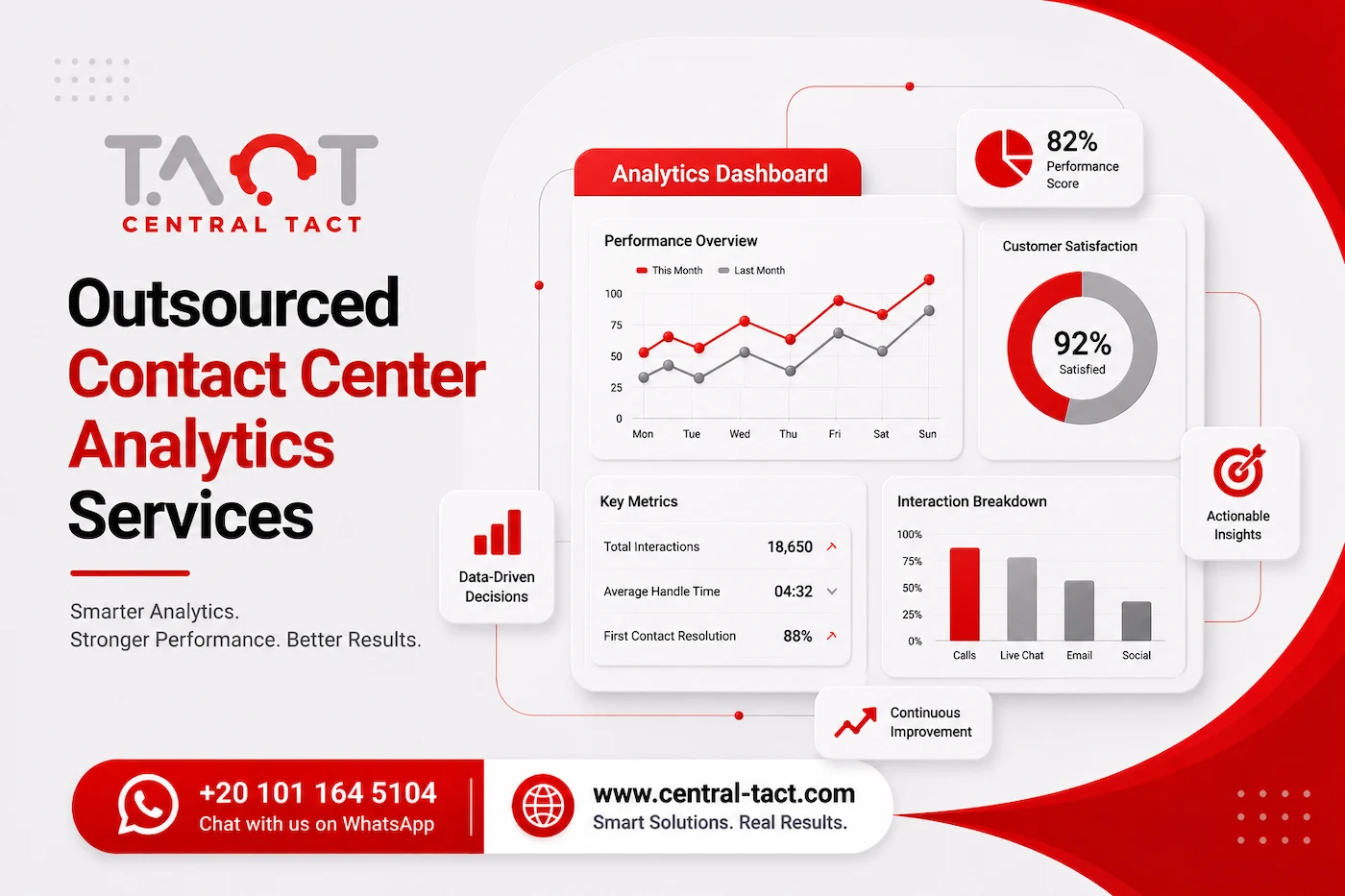
Live visibility into queue health, agent occupancy, handle time, abandonment rate, and SLA compliance — updated continuously rather than batch-processed overnight. Real-time dashboards allow supervisors to intervene during a shift rather than discovering problems in the next morning’s report.
Quality Monitoring and Interaction Scoring
Automated scoring of agent interactions against defined quality standards — covering compliance, empathy, resolution effectiveness, and communication quality. The best providers score a significantly higher percentage of interactions than manual review allows, with human review reserved for flagged or borderline cases.
Customer Journey Analytics
Understanding how customers move across channels before, during, and after a contact center interaction. Which customers called after a failed self-service attempt? Which customers contacted support three times for the same issue? Journey analytics surfaces these patterns and connects them to root cause.
Speech and Text Analytics
Natural language processing applied to call recordings, chat transcripts, and email content — identifying sentiment trends, common complaint themes, emerging issues, and compliance risks at scale. This is where the most valuable insights typically reside, and where manual review is wholly inadequate for the volume involved.
Workforce Analytics and Forecasting
Staffing efficiency analysis, schedule adherence monitoring, and volume forecasting — using historical patterns and predictive modelling to ensure the right number of agents are scheduled before the volume arrives rather than after it overwhelms the queue.
Contact Center KPI Reporting
Structured weekly and monthly performance reporting that goes beyond raw metrics to connect KPI performance with business outcomes — CSAT, NPS, churn correlation, and revenue impact where applicable.
Explore how Central Tact integrates these capabilities across AI-informed contact center programs for clients across multiple markets.
How Analytics Improve Contact Center Performance
How do outsourced contact center analytics services actually improve performance?
The impact of structured analytics on contact center performance is measurable across every dimension of the operation. The most consistent improvements:
- First Call Resolution improvement — root cause analysis of repeat contacts identifies the specific issues causing customers to call back, enabling targeted process fixes rather than generic coaching
- Average Handle Time reduction — identifying the specific interaction patterns that correlate with longer calls — agent behaviour, knowledge gaps, system delays — enables targeted training and process improvement
- CSAT and NPS uplift — sentiment analysis across all interactions identifies the specific moments in conversations that drive positive and negative customer perception, enabling scripting and training adjustments based on evidence
- Escalation rate reduction — predictive escalation modelling identifies interactions at risk of escalating before they do, enabling real-time supervisor intervention
- Staffing efficiency — workforce forecasting accuracy reduces overstaffing cost and understaffing quality impact simultaneously
- Compliance risk reduction — automated compliance monitoring across all recorded interactions flags risk before it becomes a regulatory issue
The compound effect of these improvements across a contact center operation running at scale is significant. Businesses that invest in structured analytics consistently outperform those that rely on lagging indicators and manual review.
In-House vs Outsourced Analytics — What Actually Works Better?
Is it better to run contact center analytics in-house or outsource them?
The answer depends on your organisation’s size, analytics maturity, and internal capability — but for the majority of businesses evaluating this question, outsourcing delivers better outcomes faster and at lower cost.
In-house contact center analytics:
Requires a dedicated analytics team, technology investment across multiple platforms, ongoing data engineering to maintain integration with contact center infrastructure, and management capability to direct and quality-assure the analytics output. For organisations with hundreds of agents and millions of annual interactions, this investment can be justified. For most, it produces a significant overhead for modest output.
Outsourced contact center analytics:
An established provider brings existing technology infrastructure, trained analysts, quality management frameworks, and proven reporting methodologies. The client receives structured insight without bearing the technology or staffing cost — and typically receives better analytics output than an equivalent in-house team would produce, because the provider’s analysts work across multiple contact center clients and bring broader pattern recognition.
The practical differentiator is this: an outsourced analytics provider spends all of its time on analytics. An internal analyst at most contact centers spends the majority of their time on routine data extraction and report formatting — not on the analysis that generates insight.
Contact Central Tact to discuss your analytics requirements → — we will assess your current reporting setup and identify where the most valuable improvements can be delivered.
How Central Tact Delivers Data-Driven Contact Center Results
Why is Central Tact the right partner for outsourced contact center analytics services?
Central Tact is a BPO and contact center outsourcing provider with over six years of experience delivering AI-informed, analytics-driven customer support programs for businesses across the US, UK, and Gulf markets. Analytics is not a separate function at Central Tact — it is embedded in every contact center program from day one.
What Central Tact delivers through its analytics integration:
- Real-time performance dashboards giving clients live visibility into every campaign metric — queue health, agent performance, SLA compliance, and sentiment trends — accessible at any hour without waiting for reports
- Automated quality assurance scoring across a significantly higher percentage of interactions than manual review allows — with consistent scoring criteria applied regardless of shift or supervisor
- Speech analytics and sentiment monitoring that identifies escalation risks, complaint patterns, and compliance flags at the interaction level before they aggregate into systemic problems
- Structured KPI reporting that connects contact center metrics to business outcomes — CSAT correlation, churn indicators, and revenue impact measurement where applicable
- Workforce analytics and forecasting that ensures staffing levels are calibrated to actual demand patterns, reducing both overstaffing cost and understaffing quality impact
- 24/7 monitoring capability — performance visibility is maintained across all operating hours, not just during daytime management windows
Who is this suitable for?
CX directors and operations leads whose current contact center reporting is delayed, surface-level, or disconnected from business outcomes — and who need structured analytics capability without the cost and timeline of building it internally.
When should you engage Central Tact for analytics services?
Before your next performance review cycle. The organisations that can answer “why did FCR drop last month?” before the question is asked are the ones with structured analytics already in place. Engaging now means your next review cycle is driven by data rather than speculation
Outsourced contact center analytics services
cover real-time KPI dashboards, automated quality monitoring, speech and sentiment analytics, workforce forecasting, and structured performance reporting — delivered by a specialist provider rather than built internally. The outsourced model delivers faster deployment, lower technology cost, and better analytical output than most in-house teams produce. Central Tact embeds analytics across every contact center program, providing clients with live performance visibility, automated QA at scale, and data-driven management capability from day one.
FAQ — Outsourced Contact Center Analytics Services
What are outsourced contact center analytics services?
They are the delegation of contact center data collection, performance measurement, quality monitoring, and insight generation to a specialist third-party provider — delivering structured analytical capability without requiring businesses to build and maintain an internal analytics team and technology infrastructure.
What KPIs do outsourced contact center analytics services track?
Core KPIs include First Call Resolution (FCR), Average Handle Time (AHT), Customer Satisfaction Score (CSAT), Net Promoter Score (NPS), escalation rate, abandonment rate, schedule adherence, and queue health — alongside quality monitoring scores and sentiment trend data. Central Tact tracks all of these with real-time dashboards for client visibility.
How does speech analytics work in contact center outsourcing?
Speech analytics applies natural language processing to call recordings to identify sentiment, complaint patterns, compliance risks, and emerging issues at scale. It enables quality analysis across far more interactions than human review allows, surfacing specific conversation moments that drive positive or negative customer outcomes.
Is it more cost-effective to outsource contact center analytics or run them in-house?
For most businesses, outsourcing delivers better analytical output at lower cost than equivalent in-house capability — because the provider’s existing technology infrastructure, analyst expertise, and multi-client pattern recognition cannot be replicated by a single internal team without significant investment.
How quickly can Central Tact implement outsourced analytics for an existing contact center program?
Central Tact’s analytics integration is built into every program from the start. For existing programs transitioning to Central Tact’s platform, structured reporting and real-time dashboards are typically operational within two to four weeks depending on integration complexity.
What is the difference between contact center reporting and contact center analytics?
Reporting tells you what happened — call volumes, handle times, and resolution rates from a defined period. Analytics tells you why it happened and what is likely to happen next — through root cause analysis, sentiment modelling, predictive forecasting, and cross-channel journey mapping. Outsourced analytics services deliver both, structured around business outcomes rather than operational data alone.
Request a Free Analytics Audit for Your Contact Center
If your contact center reporting tells you what happened last week but cannot tell you why — or if your quality assurance process covers a fraction of your actual interaction volume — you are operating without the visibility your business needs to make confident decisions.
Central Tact delivers real-time analytics, automated quality monitoring, structured KPI reporting, and predictive workforce forecasting — embedded in every contact center program, available to every client from day one.
Request Your Free Contact Center Analytics Audit → Or WhatApp— Tell us about your current reporting setup, your performance challenges, and your business objectives. Central Tact will identify exactly where structured analytics can deliver the most immediate improvement to your contact center operation.