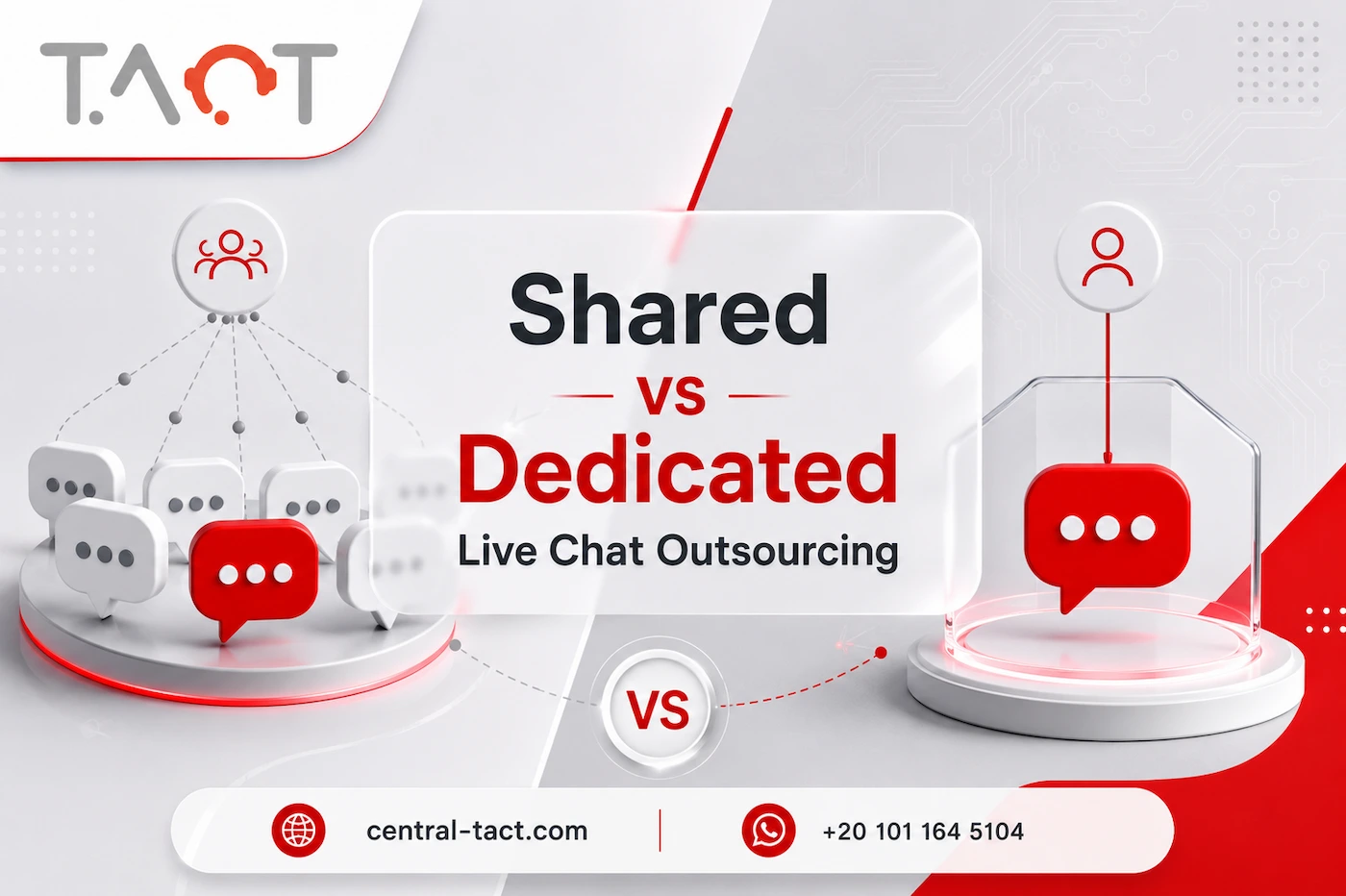
“It Depends” Is Not an Answer You Can Build a Budget Around
Ask most outsourcing providers whether you need shared or dedicated live chat agents and you will get a variation of the same non-answer: “it depends on your volume and complexity.” Technically accurate. Operationally useless.
The decision between shared service live chat outsourcing and a dedicated agent model is one of the most consequential structural choices in your customer support setup. It affects your monthly cost, your response quality, your brand consistency, and your provider’s ability to scale with you when traffic grows. Getting it wrong means either overpaying for coverage you do not need, or running a model that quietly degrades under real traffic while your CSAT scores slide.
According to LiveChat’s 2025 statistics report, 41% of customers now prefer live chat over email, phone, and social media for support. That preference means your chat channel is no longer a secondary touchpoint — it is often the first impression a prospect has of your brand. The structural decision behind who answers that chat matters more than most operations teams realize.
This guide gives you a concrete framework for making the right call — including the volume thresholds, complexity signals, and cost comparisons that most providers would rather you did not have before the sales conversation.
What Is Shared Service Live Chat Outsourcing?
In a shared service model, a pool of trained agents handles chat queues for multiple client organizations simultaneously. Your business is one of several accounts those agents cover, with intelligent routing software managing incoming conversations and directing them to available agents trained on your FAQs and scripts.
The economics are straightforward. Because agent time is distributed across clients, you pay only for the interactions handled — not for an agent sitting idle between chats. This makes 24/7 coverage financially accessible even for smaller businesses, and setup is faster because agents are already operational and simply need onboarding to your specific knowledge base.
The tradeoff is depth. Shared agents develop familiarity with your scripts, not your product. An agent simultaneously covering multiple client accounts cannot build the same contextual judgment as someone working exclusively on your business. That gap is acceptable for standardized queries — order status, appointment booking, basic FAQ responses — and becomes a real problem the moment a customer raises something outside the script.
The shared model works well when your chat volume sits below roughly 800–1,000 conversations per month, your queries are mostly predictable, and your brand voice does not require significant nuance in written communication. Push past those thresholds without adjusting your model and the cracks start showing in your first contact resolution rates.
What Is Dedicated Live Chat Outsourcing?
Dedicated agents work exclusively on your account. They handle only your chats, follow only your escalation paths, and over time build the kind of product intuition that shared agents structurally cannot develop — regardless of how good the scripts are.
The difference shows up most clearly in two metrics: first contact resolution (FCR) and customer satisfaction (CSAT). For most SaaS and e-commerce companies — where product knowledge depth materially affects resolution quality — dedicated agents consistently deliver better outcomes. An agent who has spent weeks on your account knows which edge cases come up repeatedly, which customers need extra patience, and which issues signal a deeper product problem worth flagging to your team. Shared agents know the FAQ.
Dedicated agents cost more. The premium over shared is typically 30–60% per agent hour depending on provider and scope. But that comparison only tells part of the story. A shared agent who cannot resolve a chat fully on first contact creates a second interaction — sometimes a phone call, sometimes an escalation email — that costs far more than the hourly premium of a dedicated agent. When you measure cost per resolved issue rather than cost per chat, the gap between the two models frequently narrows, and sometimes inverts entirely.
The dedicated model earns its price when your average chat involves product-specific questions requiring contextual judgment, your brand voice is a measurable competitive differentiator, or your monthly volume is high enough that agent idle time is minimal.
Not sure which model fits your current volume? Central Tact’s live chat outsourcing team assesses your chat data and recommends the right structure — free consultation, no obligation.
Cost, Coverage, and Brand Control: The Real Comparison
Here is how the two models compare across the variables that actually drive the decision:
| Factor | Shared Service | Dedicated Agents |
| Monthly cost | Lower — pay per interaction | Higher — pay per agent/hour |
| Best volume range | Under ~1,000 chats/month | Over ~1,000 chats/month |
| Setup time | 1–2 weeks | 2–4 weeks |
| Brand voice consistency | Moderate | High |
| Product knowledge depth | Script-level | Experience-level |
| First contact resolution | 60–75% typical | 80–90%+ |
| Scalability | Fast — pool absorbs spikes | Requires advance planning |
| 24/7 coverage cost | More affordable | Higher |
| Best for | FAQs, lead capture | SaaS, healthcare, complex sales |
A third option worth considering is the blended model — a dedicated core team handling primary business hours, paired with shared agents covering overnight and weekend volume. This is how most mature BPO live chat outsourcing operations structure themselves for mid-size businesses: depth during highest-value hours, cost efficiency during lower-traffic periods.
The brand control question is where most buyers underestimate the shared model’s real limitation. It is not about agent professionalism — shared agents are trained professionals. It is about whether an agent splitting attention across multiple accounts can maintain the same voice, the same judgment on ambiguous situations, and the same product intuition as someone working exclusively on your account for months. They cannot. Whether that gap matters depends on what your customers expect from a chat interaction with your brand.
A Decision Framework With Actual Numbers
This is what most outsourcing guides avoid — committing to specific guidance rather than hedging with “it depends.”
Choose shared service live chat outsourcing if:
- Monthly chat volume is under 800–1,000 conversations
- The majority of queries are predictable: order tracking, FAQs, appointment booking, basic troubleshooting
- You are an early-stage business where cost efficiency is the primary constraint
- You need 24/7 coverage but cannot justify dedicated overnight headcount
- You are testing chat outsourcing for the first time before committing to a larger model
Choose dedicated live chat agents if:
- Monthly volume exceeds 1,000–1,500 conversations and is trending upward
- Your product requires contextual knowledge — SaaS feature tiers, healthcare protocols, complex e-commerce with many SKUs
- Brand voice consistency directly affects conversion rates or satisfaction scores
- You have measured FCR below 70% with a previous shared model
- Your chat channel handles pre-sales conversations — a missed pre-sales chat is a missed sale, not just a missed support ticket
Consider a blended model if:
- Daytime volume justifies dedicated agents but overnight traffic does not
- You have seasonal spikes — campaigns, product launches, holiday periods — that exceed dedicated team capacity
- You want dedicated agents for high-value segments and shared coverage for general enquiries
The most common mistake is staying in the shared model past the point where it stops performing — typically when monthly volume crosses 1,200 conversations and query complexity begins creeping above FAQ-level. At that point the cost saving from shared agents is being consumed by repeat contacts, escalations, and declining CSAT that nobody has directly attributed to the model.
How Central Tact Structures Both Models
Central Tact provides both shared and dedicated live chat outsourcing — and gives clients an honest recommendation based on actual volume and complexity data rather than defaulting to whichever model has the higher margin.
What separates Central Tact’s approach is the quality oversight infrastructure behind both models. AI-assisted quality monitoring covers 100% of chat interactions — not a sampled percentage. Clients have real-time access to performance reporting at any time. In a shared model especially, where quality consistency across agents is harder to maintain, full-coverage QA is what keeps the model from degrading under real operational pressure.
On tooling: Central Tact integrates with Intercom, Zendesk, Freshdesk, LiveChat, Tidio, HubSpot, and other major platforms — no forced migration away from your existing stack. The team operates within your tools from day one, cutting onboarding time significantly.
Central Tact also provides bilingual Arabic-English live chat coverage — directly relevant for businesses targeting Gulf markets, where an English-only shared agent pool fails a meaningful portion of incoming traffic. For e-commerce and SaaS businesses with MENA customer bases, this is not a feature. It is a baseline requirement.
Learn more about Central Tact and review all available services before your first conversation.
What is shared service live chat outsourcing?
A pool of trained agents handles chat interactions for multiple client businesses simultaneously, making it more cost-effective than dedicated agents. It suits businesses with under 1,000 monthly chats and standardized query types. Dedicated agents work exclusively on one account, delivering 80–90%+ first contact resolution versus 60–75% for shared models. The right choice depends on monthly volume, query complexity, and whether brand voice directly affects your revenue.
FAQ
What is the cost difference between shared and dedicated live chat agents?
Dedicated agents cost 30–60% more per hour than shared agents. The real comparison shifts when you measure cost per resolved issue — a shared agent generating repeat contacts from unresolved queries often costs more in total than a dedicated agent who resolves on first contact.
How many monthly chats do I need before dedicated agents make financial sense?
800–1,000 chats per month is the lower boundary most operations teams use. At that volume, agent idle time drops enough that the dedicated premium becomes cost-justifiable — especially when query complexity is also increasing.
Can I switch from shared to dedicated agents without starting onboarding over?
Yes. A good provider retains the knowledge base built during the shared phase and uses it to accelerate dedicated agent training. Central Tact structures this transition to minimize ramp time — onboarding work already done carries forward.
Does shared service live chat work for 24/7 coverage?
Yes — it is actually one of shared service’s strongest use cases. The agent pool absorbs overnight and weekend volume without you paying for a dedicated agent’s idle time. Many businesses run dedicated agents during business hours and shared coverage overnight.
What happens when a shared agent cannot resolve a complex query?
Defined escalation paths route complex queries to a senior agent or back to the client’s internal team. The failure point is when escalation architecture is not defined before launch. Always confirm the escalation protocol in detail during onboarding, before the first chat goes live.
Is shared live chat outsourcing suitable for SaaS companies?
Generally not as the primary model. SaaS products carry feature-specific complexity that shared agents cannot handle reliably without deep product immersion. Most SaaS companies above 500 monthly chats see better outcomes from dedicated agents — because resolution quality directly affects trial-to-paid conversion and churn.
How does Central Tact maintain quality in a shared model?
Central Tact monitors 100% of chat interactions using AI-assisted quality oversight — not periodic sampling. Clients access real-time performance reporting at any time, providing visibility to catch quality drift before it affects CSAT scores.
The shared versus dedicated decision comes down to three numbers: monthly chat volume, first contact resolution rate, and the percentage of incoming chats requiring contextual product knowledge rather than script lookup. When volume is low and queries are predictable, shared service live chat outsourcing is the smarter investment. When volume crosses 1,000 conversations per month and product complexity enters the picture, dedicated agents deliver better outcomes — and usually better cost per resolved issue when measured correctly.
📞 Find the Right Live Chat Model for Your Business — Get a Free Consultation from Central Tact Toda,Or WhatsApp.
Explore Central Tact’s live chat outsourcing service or review all available services before your first conversation.