Response times on WhatsApp are judged in minutes, not hours. A customer who messages your business expects the same speed as a friend’s reply — and when an internal team can’t keep up, tickets pile up, CSAT drops, and sales slip through open chat windows. This is why more e-commerce, retail, and service businesses across the region now outsource whatsapp business support instead of staffing the channel themselves. This guide covers what outsourcing includes, how it compares to running WhatsApp support in-house, what it costs, and how to tell your business is ready for it.
What Is WhatsApp Business Support Outsourcing?
WhatsApp business support outsourcing means a third-party provider staffs, trains, and manages your customer conversations on WhatsApp, using your brand voice and your business’s WhatsApp Business API number.
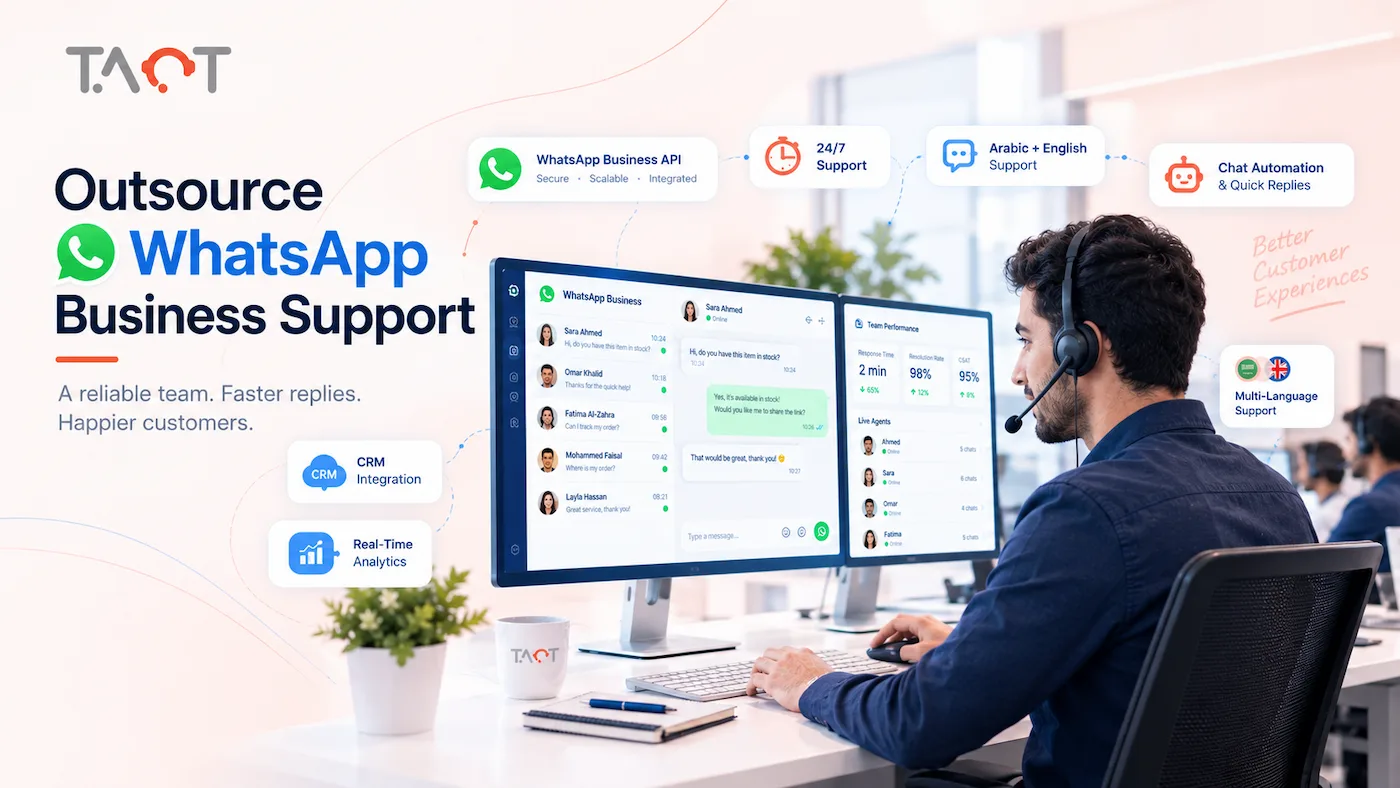
The provider handles agent hiring, shift scheduling, quality monitoring, and the technical setup of the WhatsApp Business Platform, while your team keeps ownership of pricing, policy, and product decisions. Rather than a single freelancer answering messages, you get a structured operation: trained agents, defined SLAs, escalation paths, and reporting on response time, resolution rate, and CSAT. Many providers also layer in chatbot automation for FAQs and order status, reserving human agents for conversations that need judgment.
Why WhatsApp Is the Default Support Channel in the Middle East
WhatsApp isn’t a secondary channel in MENA — for most consumers, it’s the primary one, ahead of calls, email, and Instagram DMs.
Regional adoption is driven by near-universal smartphone penetration, comfort with voice notes over typed tickets, and a shopping culture where customers ask questions before checkout. For e-commerce brands, this means WhatsApp sits directly in the purchase decision — a slow reply can cost the sale. Retailers running Instagram or TikTok ads also see most inbound traffic land in WhatsApp through click-to-chat links, making the channel a sales funnel as much as a support desk. Service businesses like clinics and logistics firms use it for bookings and reminders, raising volume well beyond simple Q&A.
What an Outsourced WhatsApp Support Team Handles
A properly scoped outsourced team covers more than “answering messages.” A typical whatsapp customer service outsourcing engagement includes:
| Task Category | Examples |
|---|---|
| Pre-sale support | Product questions, sizing, stock, pricing |
| Order management | Confirmations, tracking, delivery ETAs |
| Post-sale support | Returns, exchanges, refund status |
| Multilingual coverage | Arabic, English, and other languages |
| Automation setup | Chatbot flows, quick replies, catalog messages |
| Escalation handling | Routing complex issues to your team |
| Reporting | Response time, resolution rate, CSAT |
Outsourced whatsapp support outsourcing company teams also handle the operational side: agent rotas for evening and weekend coverage, backup staffing during sales events, and a consistent tone across agents. If you also run live chat on your website, pairing this with outsourcing live web chat agents keeps every channel on one playbook.
WhatsApp Business API vs. Standard App — What Outsourcers Actually Use
Most serious whatsapp business api outsourcing providers run support through the official WhatsApp Business API, not the free WhatsApp Business App — and the difference matters.
| Feature | WhatsApp Business App | WhatsApp Business API |
|---|---|---|
| Agents on one number | 1 device + 4 linked | Unlimited seats, shared inbox |
| Automation & chatbots | Basic auto-replies | Full flows, templates, catalog |
| CRM / helpdesk integration | None | Connects to CRM, order systems |
| Verified badge | Limited | Available after verification |
| Analytics | Minimal | Full volume, response, CSAT reporting |
| Best suited for | Solo sellers, low volume | Growing, scaling businesses |
The Business App works fine for a solo shop owner replying to a handful of chats a day. Once volume rises, or more than one agent needs the same number at once, the API becomes necessary — it’s also the only route to automation and analytics. Meta bills API usage per message as of mid-2025, with rates varying by category and recipient country; replies inside an open 24-hour window remain free in most cases. An outsourcing partner absorbs this setup and billing complexity as part of the service.
Signs You Need to Outsource Your WhatsApp Support
A few patterns reliably show up before businesses bring in an outside team:
- Response times exceed 15–20 minutes during business hours, and hours overnight or on weekends.
- One or two staff cover WhatsApp on top of other jobs, so the channel gets attention only when nothing else is urgent.
- Sales campaigns spike chat volume you can’t absorb, and follow-ups get missed once the rush passes.
- No coverage after 6 PM or on weekends, despite customers still messaging.
- No performance data — response time, resolution rate, or repeat questions go untracked.
- Multilingual demand has outgrown your team, slowing replies as agents switch languages.
If two or more sound familiar, outsourcing usually costs less than the missed sales you’re already absorbing.
Cost of Outsourced WhatsApp Support vs. In-House
Building an in-house WhatsApp team looks cheaper on paper until you add up hiring, training, and tooling costs.
| Cost Factor | In-House Team | Outsourced Team |
|---|---|---|
| Hiring & recruitment | Ongoing, weeks per hire | Included, ready to start |
| Training time | 2–4 weeks per agent | Managed by provider |
| Extended-hours coverage | Extra headcount + shift premiums | Built into the model |
| Technology (API, CRM, chatbot) | Separate setup cost | Usually bundled |
| Management overhead | You supervise QA | Provider handles QA |
| Scaling for peak season | Hard to staff up fast | Flexible seat scaling |
| Cost structure | Fixed salaries | Tied to volume, predictable |
The in-house model can make sense once you’re running a large, stable volume that justifies a dedicated internal team. For most growing businesses, outsourcing removes the recruitment cycle and turns a fixed payroll cost into a flexible one that scales with demand — useful for seasonal spikes. Pairing WhatsApp with multilingual customer support outsourcing services also avoids paying for separate teams per language.
How Central Tact Runs WhatsApp Support Teams
At Central Tact, WhatsApp support is treated as its own discipline, not an add-on to a general call center desk. Every engagement starts by mapping your current chat volume, peak hours, and common query types before agents are assigned, so staffing matches real demand.
Agents are trained on your product catalog, tone of voice, and escalation rules before taking a single live chat, and every account gets a dedicated point of contact rather than a rotating queue. We build on the WhatsApp Business API to support multiple agents on one verified number, automated quick replies, and full reporting on response time, resolution rate, and CSAT. Coverage can extend to evenings, weekends, and bilingual Arabic/English support. Review our full services page, or message our team directly: chat with us on WhatsApp.
If you’d rather talk it through first, our team is available through the contact us page to walk through your current setup and where outsourcing would help most.
FAQ
How much does it cost to outsource WhatsApp business support?
Pricing depends on chat volume, coverage hours, and language requirements, and is typically billed per agent-hour or per resolved conversation rather than a flat fee.
Can outsourced agents use my existing WhatsApp Business number?
Yes. Providers connect to your existing verified number through the WhatsApp Business API, so chat history and verified status carry over.
Is outsourcing WhatsApp support secure for customer data?
Reputable providers work within Meta’s official Business Platform, which applies end-to-end encryption, and should sign a data-handling agreement.
How quickly can an outsourced WhatsApp team start?
Most providers can onboard and go live within one to two weeks, since hiring and setup happen on their side.
Do outsourced teams handle Arabic and English WhatsApp chats?
Yes, MENA-focused providers typically staff bilingual agents by default and can add other languages as needed.
What happens to complex issues an outsourced agent can’t resolve?
Escalation rules are agreed upfront, so flagged conversations route to your internal team within a defined time window.
Can outsourced WhatsApp support scale up during sales events?
Yes — additional agents can be added temporarily for peak periods without a hiring cycle.
Does outsourcing WhatsApp support replace automation and chatbots?
No. Automation handles repetitive questions, while outsourced agents handle anything needing judgment or a human tone.
Ready to move WhatsApp support off your internal team’s plate? Contact Central Tact or message us directly on WhatsApp to scope your setup.